The speed of adversary exploitation has outrun the cycle most security programs were built to run. Defending proactively starts with knowing what an exploit actually enables next: the path it opens, the assets that path reaches, and the defenses that have to hold. The threat environment has changed and we must shift our focus from how fast can we patch to will our defenses stand up to the threats that we face and how effectively can we eliminate adversary attack paths.
Threat debt is accumulated adversary opportunity
Threat debt is the accumulated adversary opportunity in your environment. Not a count of vulnerabilities, misconfigurations, or weak controls, but the opportunity those conditions create when weighted against the adversaries who target you, what they’re capable of doing, your business-critical assets, and the defenses you’ve actually proven work.
You pay threat debt down by breaking attack paths, not by working through findings faster. A single critical path usually depends on a chain of weaknesses: a vulnerability here, a misconfiguration there, an identity gap bridging them. Break the path by hardening network segmentation, fixing the identity exposure, or validating a control that wasn’t actually working. The findings underneath stop mattering as much. A ten-thousand-finding backlog can turn out to be a fifty-path problem.
Paying down threat debt requires support across the organization. The security team may identify viable attack paths and validate where defenses fail, but the work to fix them often sits with whoever owns the firewall, the identity provider, the cloud account, or the application. Threat debt is an organizational condition, not a security team’s task list. Reducing it requires a holistic cyber defense approach with IT as a partner and the business deciding which assets and adversaries merit investment.
What contributes to threat debt?
Threat debt accumulates from across the organization, including software vulnerabilities, misconfigurations, identity and access debt, gaps in detection and response, network and firewall configuration, controls that fail under test, and the growing footprint of unmanaged AI agents and third-party integrations.
None of these become threat debt by themselves. A vulnerability is dangerous if it allows an attacker to take the next step toward a critical asset. A control weakness becomes catastrophic when identity debt bridges it to something important. The unit of measure is the path, not the finding, because that’s where the combinations become visible.
Continuously manage threat debt
Continuous Threat Exposure Management (CTEM) is the operating discipline for paying threat debt down. It’s the cycle of discovering the paths an adversary could take, validating which defenses break them, prioritizing the rest, and confirming the fixes hold. Effective CTEM programs are threat-informed, attack-path aware, and grounded in demonstrated defensive effectiveness. Without those three properties, CTEM becomes another way to produce lists.
Threat Debt Index quantifies threat debt
The Threat Debt Index is the quantitative version of threat debt. Every validated viable attack path contributes to it, and a path’s contribution is the product of three weightings:
- The business impact of the asset the path reaches
- The relevance of the adversaries whose techniques the path uses
- The residual defensive gap after validated controls are accounted for
Sum the contributions across all paths and you get the Index.
Lower is better. It’s a debt balance, not a posture score. Report the Index as both a stock and a flow: the current balance, and the net change over the period, decomposed into what was paid down (paths broken, controls validated, networks hardened) and what accrued (new paths discovered, control drift, adversary techniques evolving). That decomposition is the part boards actually use: “Threat Debt Index is 612, down 14 points this quarter, with 60 paid down and 46 accrued.”
The Threat Debt Index drives prioritization. Paths sort by contribution, so the highest-value ones come first. When several paths share a weakness, that weakness ends up at the top of the queue automatically, because fixing it collapses every path that depends on it.
The new cyber defense management paradigm
What threat debt makes possible isn’t just a different report. It’s a different way of accounting for defensive work that reduces adversary opportunity, regardless of which team did it or how the debt was paid down.
Measure performance of cybersecurity and ITSM programs by continuously quantifying and managing threat debt. This ensures that organizations are systematically paying down the debt that represents real adversary opportunity, not just addressing isolated findings.
This model fundamentally changes how value is recognized. Compensating controls must be credited when they successfully interdict attack paths, as they directly reduce threat debt without requiring remediation effort. This shifts the focus from activity tracking to proven defensive impact.
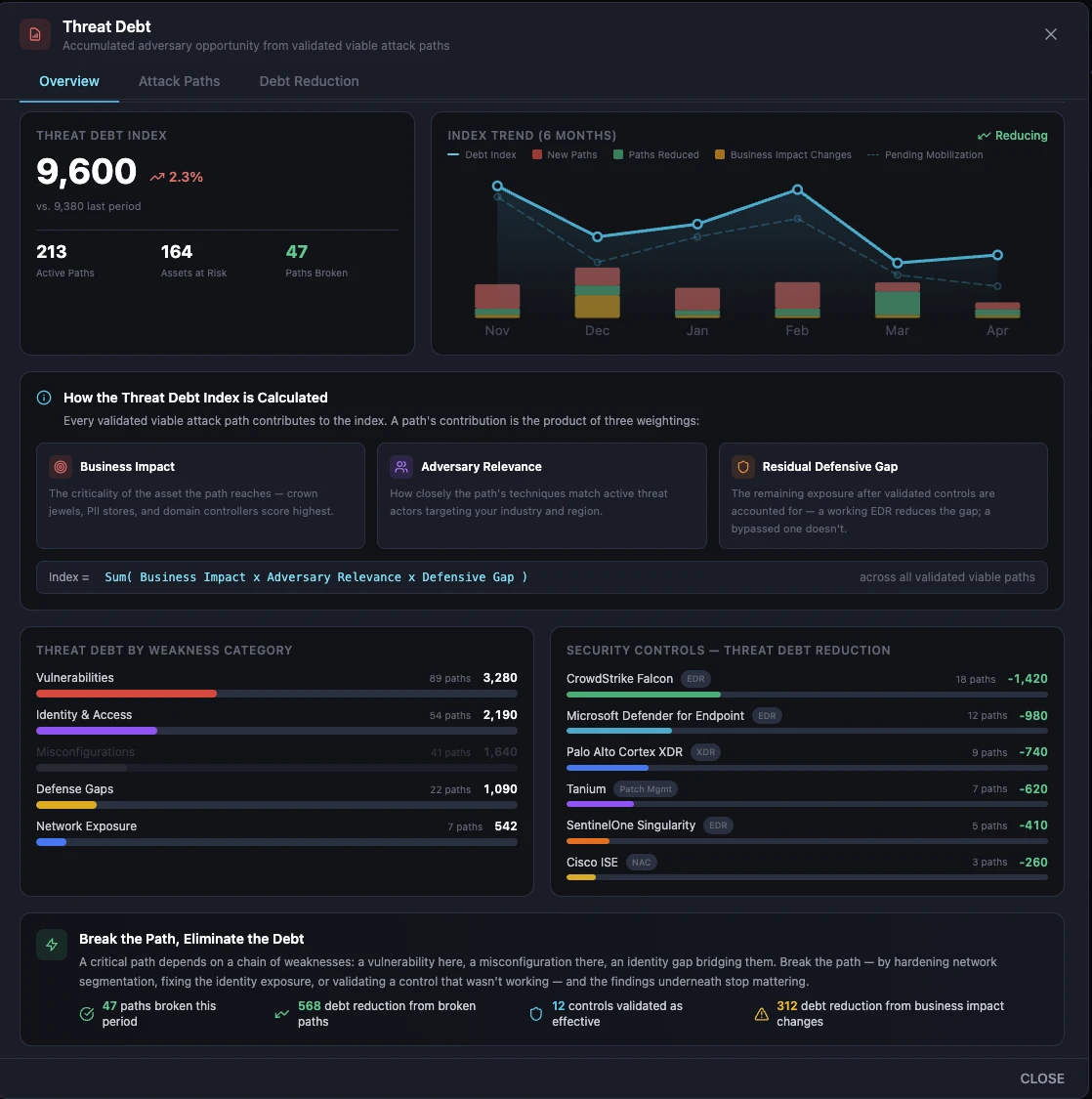
Tracked over time, threat debt behaves like a market index that provides a continuous, trending view of organizational risk. As mobilization actions are executed and controls prove effective, the index reflects measurable reduction. Importantly, organizations can also model and visualize the expected impact of mobilization plans that have not yet been fully executed, enabling forward-looking decision support—not just retrospective reporting.
Critically, this approach exposes the true ROI of security investments. It highlights which controls are actively reducing adversary opportunity, where compensating controls are eliminating the need for remediation, and where resources are being spent without meaningful impact.
What threat debt changes
Threat debt gives security, IT, and the business a shared problem and a shared scoreboard. Security identifies the paths and validates the defenses, IT owns most of the work to break them, and the business sets the priorities. Without a common frame, those three groups argue past each other about findings, severity, and patch SLAs that aren’t measuring the same thing. With one, they can prioritize, fund, and report against the same number.
Threat debt changes what gets reported to executives and the board. Boards have spent years receiving security metrics that rise and fall for reasons no one can fully explain: patch rates, vulnerability counts, mean time to remediate. The Threat Debt Index reframes the conversation around a different question: how much adversary opportunity does the organization carry, and how efficiently and effectively is it being eliminated? The answer is a number that moves for specific reasons (paths broken, controls validated, networks hardened), with a flow that shows what was paid down and what was accrued each period.