Continuous Threat Exposure Management
Break Attack Paths That Matter Most
Connect isolated exposures into real attack chains, validate whether your controls hold, and eliminate the paths that put you most at risk.

What Is Continuous Threat Exposure Management (CTEM)?
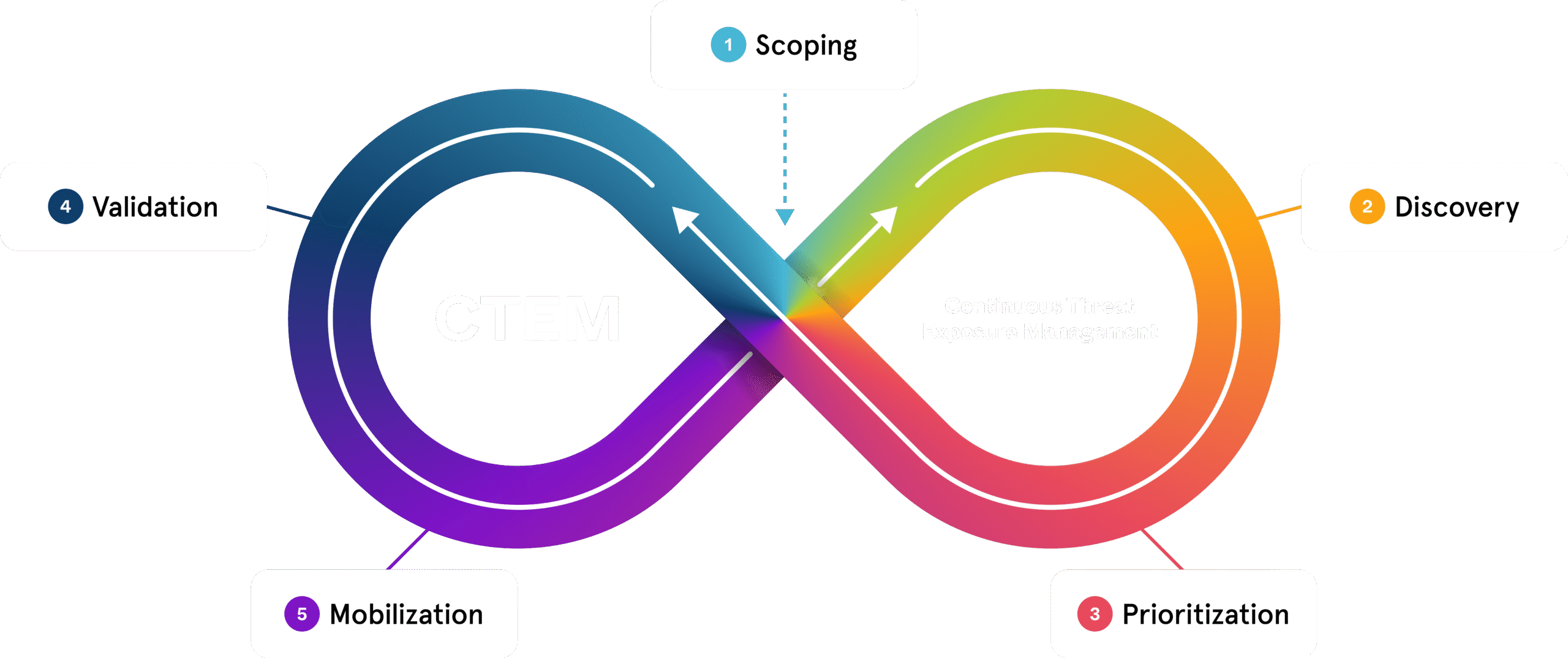
Continuous Threat Exposure Management (CTEM) is a five-stage cybersecurity framework designed to surface, prioritize, validate, and remediate exploitable vulnerabilities, misconfigurations, and attack paths. Originally defined by Gartner, the CTEM operating model focuses less on isolated findings and more on how vulnerabilities, compromised identities, cloud misconfigurations, and control gaps connect into viable attack paths targeting critical business assets.
Unlike periodic, point-in-time assessments or static reporting, an effective CTEM program establishes an ongoing decision loop. It replaces raw vulnerability data with threat-informed context, helping security and operations teams understand what is actually exploitable, where existing defenses already mitigate risk, and which specific remediation actions will measurably lower corporate threat debt over time.
The Problem
Why Exposure Data Alone Is Not Enough
The Solution
What Real CTEM Looks Like
Security teams don’t have a data problem. They have a decision problem. Severity scores treat every finding the same, but attackers don’t. The threats actually targeting your environment go unseen.
Threat Informed
Prioritized by how real attackers operate and what they target, not by generic severity scores.
Your team drowns in vulnerability lists. The backlog never shrinks, no matter how fast you patch. Real attacks rarely come from one finding. Adversaries chain multiple weaknesses together, and breaking that chain matters more than closing tickets.
Attack-Path Aware
Focused on how exposures chain into viable paths to critical assets, not on raw vulnerability counts that bury the signal in noise.
Your controls are configured, deployed, and trusted to work. Few are tested to prove they actually hold under real attack. Gaps only surface when something gets through.
Grounded in Defense Effectiveness
Measured by how your controls actually perform in your environment, not by assumptions or configurations alone.
Most security programs measure outputs, not outcomes. Dashboards turn green but no one knows whether real risk is going up or down. Activity isn’t the same as progress.
The Outcome
Less threat debt. Not more activity.

“You’re not just testing controls—you’re proving readiness. That’s the leap CTEM enables. Security teams often don’t struggle with data, they struggle with decision-making. CTEM gives you the structure to prioritize based on what the business actually cares about: what’s exploitable and what’s impactful.”
—Chris Kennedy, CISO, Group 1001
How CTEM Actually Runs
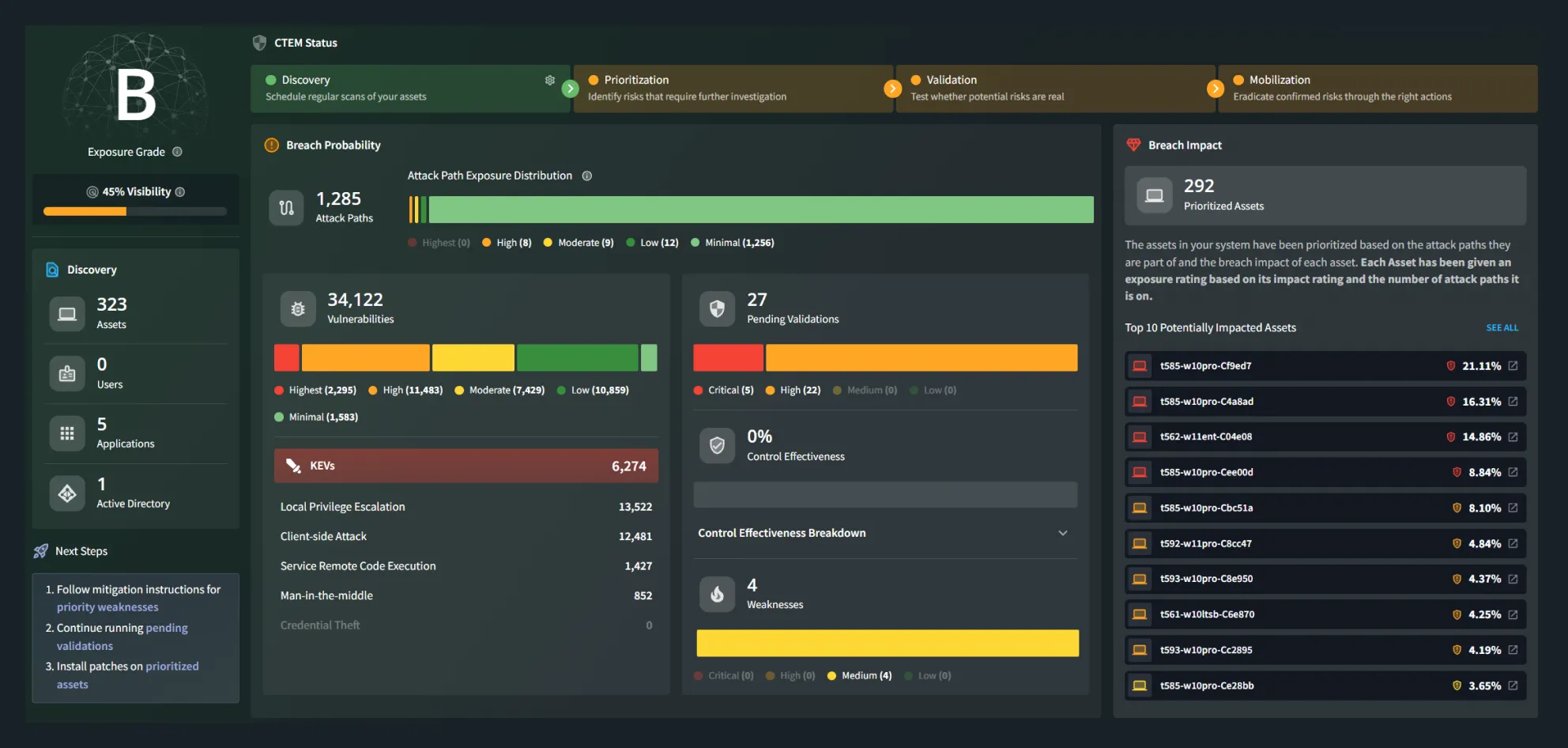
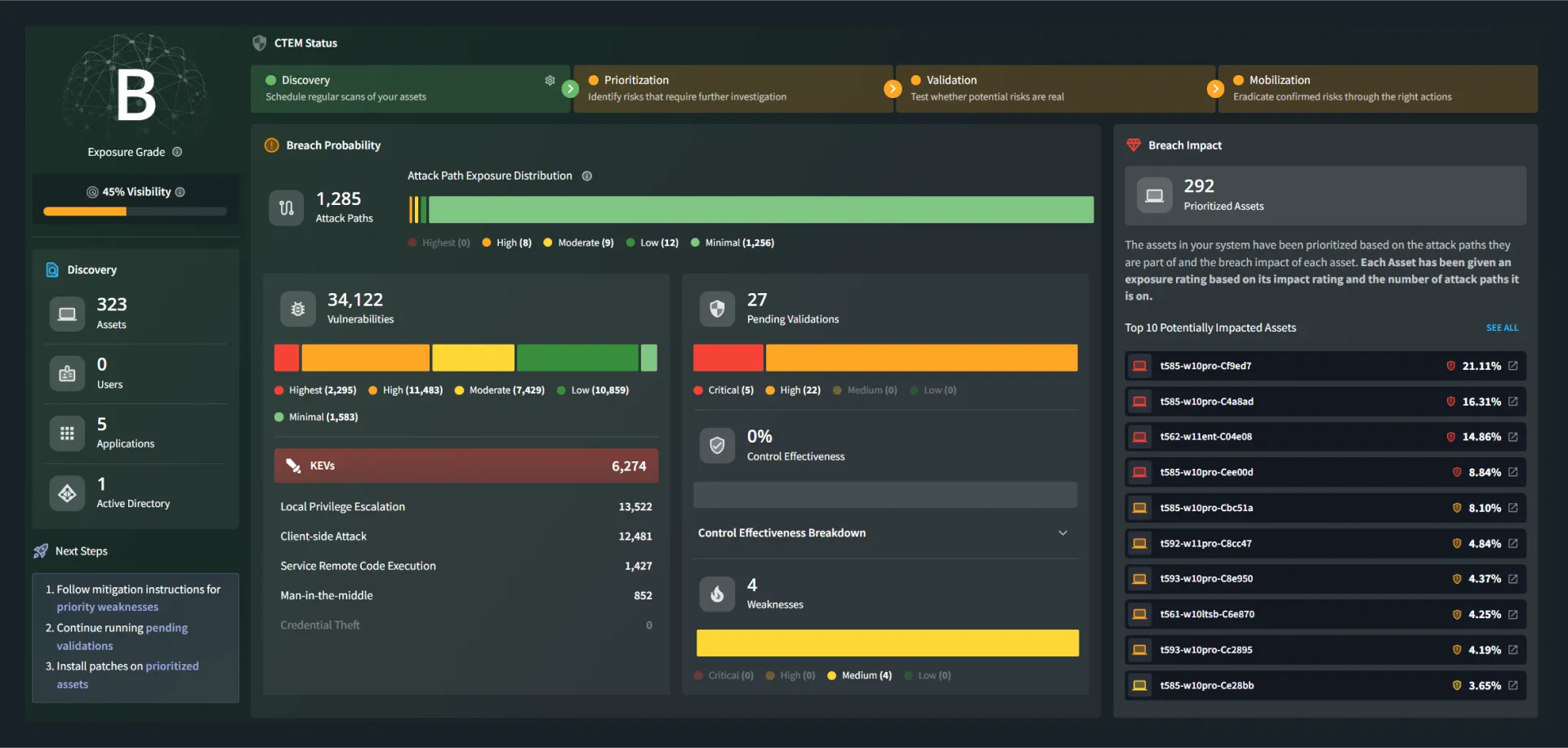
To move from exposure data to defensible action, CTEM runs across five stages. Each stage adds the context needed to decide what to do next and prove that risk is going down.
Why CTEM Runs Better on AttackIQ
Most organizations treat CTEM as a project, and most vendors only deliver pieces of it. AttackIQ runs CTEM as an operational practice, delivering a level of proof, precision, and pioneering work that competitors can’t match.
Validation
Proof, Not Promises
Exposure tools guess what might be wrong. AttackIQ uses real-world adversary emulations to prove exactly what your defenses block, detect late, or miss entirely.
Risk Measurement
Precision, Not Proxies
Legacy metrics count activity like tickets closed. The AttackIQ Threat Debt Index quantifies adversary opportunity across every attack path: created, broken, compensated, or accepted. Leaders see the balance, not administrative output.
CTEM Workflow
Practice, Not Pieces
Most tools cover only one or two stages of CTEM, forcing teams to stitch together separate products. AttackIQ operationalizes the full lifecycle in a single platform.
Threat-Informed Defense
Pioneers, Not Participants
As a founding Research Partner of the MITRE Center for Threat-Informed Defense, AttackIQ helps build the frameworks others copy. That research is embedded in the platform so customers can scale ATT&CK coverage faster.
Built for Every CTEM Role
CTEM is not a one‑team job. From CISOs to IT Ops, every role helps reduce exposure and prove the program is working.
CISO
Translate technical exposure into board-ready risk reporting. Track threat debt, model mobilization plans, and quantify how investments reduce attacker opportunity.
CTEM Leader
Run a repeatable operating motion across teams. Prioritize attack paths, coordinate decision owners, and report threat debt reduction on a consistent cadence.
SOC Analyst
Focus operational effort where it counts. See which controls blocked, detected late, or missed adversary behavior, then direct hunting and response to validated gaps.
Detection Engineer
Close coverage gaps with evidence. Measure detection performance by rule and MITRE ATT&CK technique, then use AI-assisted tuning to improve rule quality faster.
Red & Purple Team
Scale offensive operations without scaling headcount. Run ATT&CK-aligned emulations, automate scenario creation, and turn one-off engagements into an ongoing practice.
I&O / IT Operations
FSpend remediation effort where it reduces risk. Know which fixes break attack paths, where compensating controls help, and how patching contributes to threat debt reduction.
Frequently Asked Questions About CTEM
CTEM stands for Continuous Threat Exposure Management. It is a security operating model for identifying, prioritizing, validating, and reducing exploitable exposures across the environment.
The five stages of CTEM are scoping, discovery, prioritization, validation, and mobilization. Together, they create an ongoing cycle for reducing attacker opportunity.
Vulnerability management focuses primarily on identifying and remediating CVEs. CTEM expands beyond vulnerabilities to include identities, misconfigurations, attack paths, and defensive weaknesses, then validates whether those exposures can actually be exploited in the environment. Read our full CTEM vs. Vulnerability Management comparison
Exposure management helps organizations identify and prioritize risk. CTEM extends beyond prioritization by validating exploitability, testing defenses, and operationalizing remediation and hardening efforts.
BAS is a validation technique for emulating adversary behavior and testing security controls. CTEM is the broader operating model that includes validation alongside scoping, discovery, prioritization, and mobilization.
Threat debt is the exploitable opportunity that accumulates when exposures, defensive gaps, and attack paths remain unresolved over time. Reducing threat debt means systematically removing the paths attackers can use to reach critical systems.
AttackIQ helps organizations establish a repeatable CTEM operating model in as little as 90 days, moving from initial scoping and prioritization to validated outcomes and measurable reduction in attacker opportunity.
AttackIQ operationalizes CTEM end-to-end by connecting exposures into attack paths, validating exploitability and defensive effectiveness, prioritizing what matters most, and driving validated risk reduction.
Measure What Matters
The Goal Is Not Fewer Findings
It’s Less Threat Debt
See which attack paths matter, which controls fail, and which actions measurably reduce threat debt in your environment.