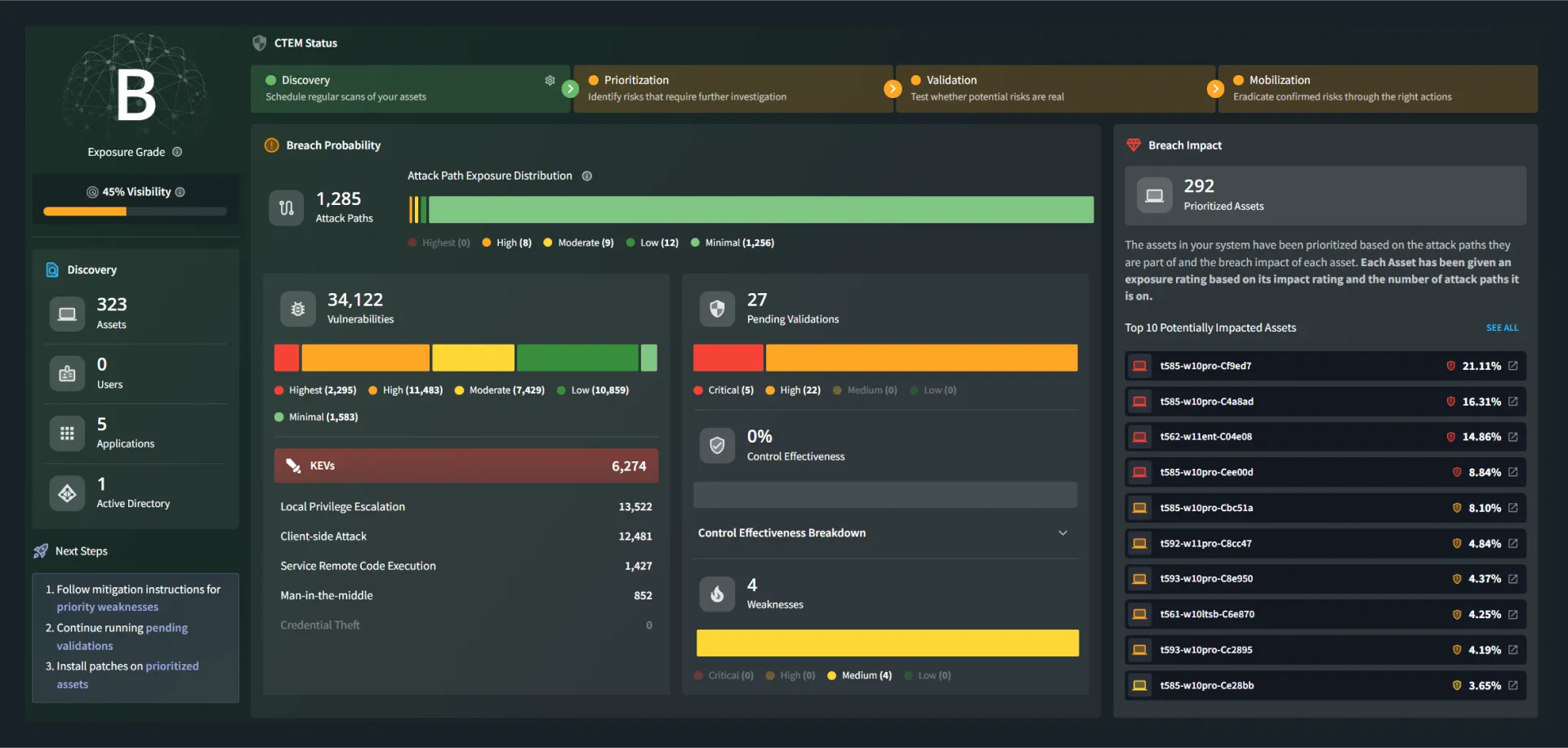
Transform Vulnerability Management with Strategic Prioritization.
Validate vulnerabilities in context with continuous testing and threat-informed prioritization—focusing on what’s exploitable and poses the greatest risk to your business.
From Alert Fatigue to Real Risk Reduction
Replace CVSS-driven vulnerability chasing with validated, business-aligned risk management. AttackIQ combines threat intelligence, asset criticality, and continuous control validation to identify the exposures that truly matter.
The Old WayCVSS-Driven Chaos
- Drowning in 40,000+ CVEs a year, many labeled “critical”
- Up to 95% of remediation effort wasted on non-exploitable issues
- CVSS scores lack business context and exploitability insight
- Alert fatigue masks real threats and delays response
The AttackIQ WayValidated Risk Prioritization
Because “High Severity” Doesn’t Mean High Risk
Cut Through the Noise
Focus only on the vulnerabilities that are exploitable in your environment—not just high CVSS scores.
Learn MoreMake Remediation Count
Reduce wasted effort by directing patching and mitigation toward real, validated exposures.
Learn MoreShift from Reactive to Strategic
Replace reactive patching and compliance fire drills with continuous, validated prioritization that targets real risk.
Learn MoreProve Security ROI
Track meaningful metrics like validated risk reduction and improved control performance.
Learn MoreContinuously Shrink Your Attack Surface
Break attack chains, eliminate exploitable paths, and maintain resilience over time.
Learn MorePrioritize Smarter. Validate Continuously.
AttackIQ turns vulnerability overload into clarity—giving you the context to prioritize what matters, the validation to confirm what’s truly exploitable, and the confidence that your defenses will hold.
Validate What Attackers Can Actually Exploit
Focus on Validated Risk
Expose Attack Paths, Not Just CVEs
FAQ
Never Settle for Uncertainty
Validate Your Defenses
Take the guesswork out of threat exposure management. Validate your defenses with real-world attack scenarios and focus on what matters most—managing your risk.
Featured Articles
-
Watch Webinar

-
 Vulnerability Management identifies and remediates technical weaknesses in systems and software, while Continuous Threat Exposure Management (CTEM) takes a broader approach by assessing an organization’s complete attack surface, including technical vulnerabilities, misconfigurations, and human factors, to prioritize remediation based on exploitability and business risk.
Read More -
Read More